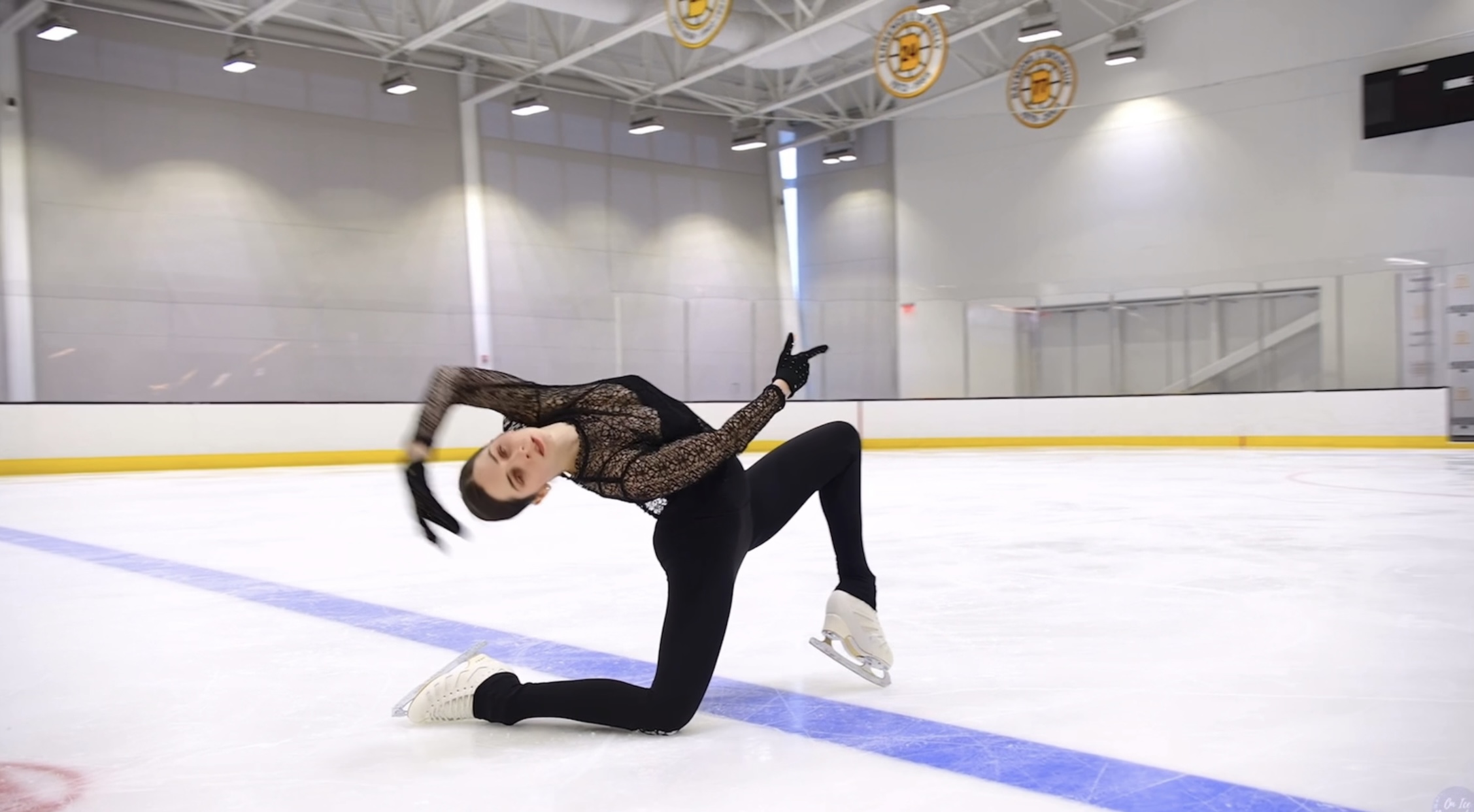
Congratulations to Paula Jagodzinska, our most recent graduate of the AIT Mentorship Program!

As part of Paula’s mentorship program, she wrote a thesis on the diverse nature of the choreographic process, identifying four key concepts crucial for effective choreography: the balance between intuition and cognition, understanding the skaters as the “muse,” the significance of intention in conveying messages through movement, and actively seeking inspiration from diverse sources. It underscores the importance of embracing a personalized and exploratory approach to choreography while integrating these concepts.
Choreographers interviewed in the thesis include Simone Grigorescu Alexander, Doug Webster, Adam Blake, Mark Pillay, Katherine Hill and Nathan Birch.
Paula also completed a choreographed final piece called “A Way of Being” (video above).
Congratulations Paula! Her work will serve as important research for the choreographic process in figure skating!
This AIT Mentorship Program is a customized, one-on-one, online course for skating choreographers with the chance to build their choreography skills, resources, teaching vocabulary, and skating network. For more information, go to the link in our bio or visit http://www.americanicetheatre.org and visit theOpportunities tab.
Below is Paula’s final video project and thesis paper in its entirety.
===
Exploration of The Choreographic Process
by Paula Jagodzinska, 26th March 2024
The Choreographic Process is the method by which choreography is developed. There is a broad spectrum of possibilities that can be explored, however there isn’t one perfect roadmap that must be followed. I have found that a successful choreographer follows a choreographic process unique to their style and skillset. To further my insights, I interviewed Adam Blake, Douglas Webster (Ice Dance International), Katherine Hill, Mark Pillay, Nathan Birch (The Next Ice Age) and Simone Grigorescu. Through interviewing these 6 noteworthy skating choreographers and conducting in-depth research, I have drawn similarities between their approaches. Coming to find which concepts are used most consistently and effectively when exploring the choreographic process. The 4 fundamental concepts worth exploring in the choreographic process are the synergy of intuition and cognition, the understanding of one’s “muse”, the importance of intention, and the act of finding inspiration. These four concepts do not have to follow the order in which they are listed. They can all be a starting point for exploration of the choreographic process.
Concept 1: The synergy of intuition and cognition
The choreographic process can be approached from two frames of mind; through intuition and cognition. A balance between both creates synergy and a great exploration ground. Intuition is the instantaneous ability to know something without the conscious use of analytical reasoning. Cognition is the mental function of processing information through experience, conscious thought and the senses. Intuition is often referred to as ‘thinking with your gut’ and cognition as ‘thinking with your head’.
Intuition guides the choreographic process through subtle senses. Surfacing as an unexplained inclination, a sudden stroke of insight or perhaps a visualisation. I believe it’s important to tune into intuition and allow yourself to follow these subconscious suggestions. They can be great initiators in guiding the choreographic process. Nathan Birch signifies this by saying “There is a ‘key’, that unlocks a door. The ‘key’ is hard to predict and has always been different, such as music or a physical visual. One common thing is paying attention and recognising a ‘key’ that is turning in a door that is opening.”
In a natural state of being, you create from a place of authenticity. This is where intuition leads you to creative flow, finding what works for you. Simone Grigorescu believes all artists have a process that feels more natural than others. She refers to the brilliance of intuition by stating, “Flow, is that place where ideas seem to manifest instantly and effortlessly and usually produce the most rewarding results”.
Improvisation is a technique which relies heavily on intuitive movement. When improvisation speaks through you, it’s important to capture the initial inclinations. As you will often face frustration trying to recreate the spark with which they first appeared.
Katherine Hill’s best ideas come out, when she first steps on the ice, puts on the music and has her choreographic partner film her improvisation. Capturing the first ideas without thought.
Trust is important when recognising the pull of intuition, you must trust it enough to see where it’s leading you. Choose to surrender and follow through on your instincts. Mark Pillay recalls Sandra Bezic saying, “As long as you have one idea when you get on the ice, that’s all you need”. If you have one idea, you can grow from there and learn to trust that you will get there no matter what. You must not second guess yourself but simply allow it to all fall into place. Nathan Birch supports this, stating that it’s important to get out of your own way. You must trust yourself, trust the process and forge a path of least resistance, “Allowing the dance to be born and breathe”.
On the other hand, cognition informs the choreographic process through mechanisms such as motor skills, memory retrieval from external stimuli, planning and problem-solving.
Movement-based choreography requires motor skills. Choreographic devices come into play, referring to the compositional elements of time, space, energy and form. Providing you with a toolbox of techniques to further expand and develop movement. Adam Blake believes that choreographic devices are great and known tools used to communicate when creating movement-based choreography.
Ideas are stimulated through the memory retrieval of external stimuli. This is where most of Adam’s choreographic process begins. He says, “I choreograph from a place of nerd” where he immerses himself in the subject. Learning as much as he can about the properties of external stimuli. Exploring themes such as anime, cartoons, folklore history, storylines and tv shows. Retelling stories and making them relatable. Just as tv-show producers work behind the scenes to create familiar stories, to pull at heart strings.
Cognition is also applied when approaching the choreographic process through a lens of problem-solving and planning. Following a mind map of ideas, can create movement innovation. Katherine Hill likens this to a business brainstorm, creating iterations and following the “What If?” what if we did this, what if we did that.
Planning also includes the spatial pathways created in choreography. Douglas Webster claims the architectural design of a piece, is one of his greatest assets. He knows exactly how long it takes to get people from point A to B. Often comparing his planning to movement in nature such as birds flocking.
When music initiates the choreographic process, synergy of intuition and cognition is seen.
Music has the ability to touch the soul, and the power to connect body and mind. It stimulates visualisation, dictating how to move and what to feel. This intuitive vision then turns to cognition, developing vision into movement. Simone believes that music creates the canvas. She immerses herself in the music, until she becomes one with it. Allowing the music to create a video in her mind’s eye. Forming the intention and movement that will communicate the stories, messages or feelings. Mark’s mind is curated to constantly be on the prowl for music. Music has always been the touchstone that develops everything for Mark. He will obsessively listen to a piece of music and choreograph a template in his mind right away. Douglas relates to this as well by saying “I sit with the music and I just listen and I dream”, then he creates count sheets and develops the structure, pattern and design of the movement.
The choreographic process can be initiated through both intuition and cognition. It’s not imperative which one comes first; one is not better than the other. They are both of essence and can be applied alone. However, creating synergy between the two allows for greater grounds of exploration and possibility. The choreographic process differs for everyone, it’s important to recognise what you’re instinctively drawn to doing, what your strong suits are and what works best for you. With this awareness you may work towards balancing intuition and cognition through your choreographic process; reaping rewards from the best of both worlds. As Einstein once put it “The intuitive mind is a sacred gift and the rational mind is a faithful servant…”.
Concept 2: The understanding of one’s “muse”
The second concept worthy of great consideration is the understanding of one’s muse. What and who is one’s muse? The term ‘muse’ has many meanings in the world of creativity and choreography. Traditionally the ‘muse’ is a person who serves as the source of an artist’s inspiration. For the purpose of this paper, I’m referring to the bodies you are working with as a choreographer. These are the skaters in front of you, who will be transmuting your ideas into tangible pieces of work.
To build a connection with your muse, it’s crucial to create a safe and supportive environment. Making them feel seen, heard and understood will help encourage their confidence and trust in you. Mark Pillay enjoys making his skaters laugh and works actively to have them trust his vision and the choices he’s making. He finds it helpful to discern whether they are visual or kinaesthetic learners, working out the best way they will learn from him. Mistakes are valuable, showing the way a skater wants to naturally move. Mark will often work with that, stepping into a more collaborative approach.
Adam Blake also choreographs from a place of massive collaboration. Finding out what the skater really wants to do and then tweaking it, to create something really different.
Collaboration is a humble act. It goes beyond ego, self-glorification and the need for approval. It creates an opening to possibility and greatness. The work will tend to reveal itself excitingly when you collaborate with your muse and other creatives. When working with difficult people Adam says “It’s important to change your mindset from creative control to collaborator and figure out how to merge ideas together.”
To develop the choreography and bring your vision to life, it’s important to understand the ability of your skaters. Knowing what you want and how to draw it out of them. As mentioned in the book, ‘The Intimate Act of Choreography’, “Your dancers are human beings; they are also your clay”1. Nathan Birch expands on this by explaining that it is enormously helpful to know how you want your skaters trained technique wise. Training them to move the way you want, moulding them into your shape and what you envision skating to look like. You then create the perfect mold to be able to break the mold. Creating space to experiment but having a common place the skaters can always return to.
The talent of your muse plays a big role in transposing your vision to the ice. It’s important to acknowledge that the capabilities of your muse sometimes lie outside of your control. The eye of the choreographer has the ability to look deeper. See past the skaters’ limitations and spot potential, to what might otherwise be invisible.
Adam Blake comes across this when working in a show setting, he says “You have a group of able bodies, but how able are they?”. In situations like this Adam has his “arsenal”. A set of formations, ideas or different universes he can trail down depending on what is needed for that group. Whilst working for Cirque Du Soleil, Katherine Hill was given an intention from the director, but then it very much relied on aligning to what the performer could do.
You must remain adaptable and avoid becoming attached to your ideas. Learning to see and understand the final product. Katherine recalls Phillip Mills telling her “…there’s the program I imagine in my head, then there’s the program that I give the skater, then there’s the program the skater learns, and then there’s the program that they perform”.
Knowing when to let go and find compromise, will ease your mind as you transition through the choreographic process. Simone Grigorescu believes there’s always compromise between what’s in your head and the result you can get. The times that you can transpose your vision exactly onto the ice, is rare and phenomenal. She emphasises “I think it is important to understand that one can have the most brilliant vision in their mind but if one doesn’t have the appropriate people to bring that vision to life, it will not have the desired effect.”
Timing is also key, when facing the muse and factors outside of your control. Mark Pillay puts it down to timing. When everything lines up perfectly and the audience comes behind to love the program. A magic thing happens and it’s meant to be, “Putting the right music, to the right student, in the right moment”.
Focus often falls solely on the body of the muse and the way it moves across the ice. Nathan Birch brings up a valid point through his time and experience. The one point of reference a skater has is the blade; the blade is the one thing that is a constant. The body limbs, lines created and lean into or out of the circle all have one measurement to compare to; where the blade is. Taking this into consideration and becoming aware of the blade in relation to your muse, could lead to very interesting movement and yield innovative choreography.
Once the work is finished, it is in the hands of your muse. You must step back, allowing them to be free within it. The muse can only relish in the piece and bring it to life through your detailed guidance and support. It is your responsibility as the choreographer to cultivate and nurture your muse along the way for this to happen, “After all, you are the one who chose them to be the instrument of your design and utter your message.”2
Concept 3: The importance of intention
The third fundamental concept that informs the choreographic process is intention. Intention is the purpose of your work and what you aim to communicate through your choreography. It is a powerful and meaningful tool as it creates clarity and emotionally connects the audience to your work.
Intention awakens something in you first, and then it allows something to be awakened in others. A valuable point to consider is that you cannot control how the audience will react and interpret your work. Whether they will receive your intended message and understand the choreography as you anticipated, “Remember that you, as creator, only provide the feast; you cannot control how it will be eaten, what it will taste like on different palates, when it will be digested.”3 It’s important to stay true to your creative voice and stand by the message you wish to share. Furthering this thought Nathan Birch deems that movement puts out thought forms, like a pebble thrown into still water. With the rings going out forever, still ringing somewhere even when they seem to have dissipated. He feels he has been given this medium to create a better world, whether people see it or not.
There are many questions to consider when working around your intention. Douglas Webster likens this to the Meisner technique for acting (Sanford Meisner NYC). Questioning: who, where, why, what. Consider who are the skaters in the work, where are they, why are they together, what are they doing. Objective is big in acting, what do you ultimately want for people to come away with? Once you know your objective and details around intention, you can add verbs to create movement. These verbs give real intent behind the movement. Similarly, intention is everything for Adam Blake. He often questions ‘why are you doing something’ to avoid the unnecessary. Adam views intention as building a bridge between what’s in his head to the audience via his medium of skaters. There’s a specific joy and magic for the finished product and collaboration. Adam loves when people walk away feeling empowered. He recalls being moved by the excited reaction of a Columbian family feeling represented, whilst watching his choreography during ‘Encanto, Disney On Ice’.
Simone Grigorescu recalls a great example of the power of intention. Simone and Adam collaborated on a piece about the consequent fall of the Berlin Wall and the coming together of both sides. The conditions for choreographing this piece were very stressful, with no props or special lighting. The choreography was performed well but it wasn’t anything extraordinary. When the ‘wall’ (created by skaters’ bodies) came down and the skaters united, it had a huge impact. People knew the song and knew the history. It triggered their memories and the emotional response was clear. The audience was touched by their strong use of intention. Douglas Webster likewise aims to move people deeply through intention, making them feel emotionally connected to the work. He also likes to think about the composer’s and artist’s intentions behind the music and how he can serve that intention.
Clarity of intention is vital in getting your message across. You need to be very specific and clear in your choices, “With clearness of articulation there comes clearness of communication…”4. Simone stresses the importance of knowing which movements to use to convey your message. In show productions, you must transpose the script onto the ice. Intention must be put behind the choreography to intend exactly what’s on the paper.
The word intention has a very broad concept. It can be complicated with deep meaning or simply be a word, verb or feeling. Intention can be closely linked to the choreographer’s emotion, acting as a therapeutic outlet. Mark Pillay views choreography and the intention behind it as a way to let go of emotion. He takes the emotional state of a feeling and puts it into his choreography and then it’s no longer holding space in his body.
One final takeaway is that movement is full of symbolic meanings. Through the use of intention, you can make a lasting impact on the perceiver whether you are aware of it or not. Intention is the magical instrument that connects the audience to your work. It allows them to become a part of it and provides them with something to walk away with. This is reiterated in this following extract, “What is that intangible something that makes an imprint on the perceiver? What is left when all else is taken away, that which the audience has when the curtain has gone down? It is the total involvement of a body and being expressing the symbolic intent of the dance.”5
Concept 4: The act of finding inspiration
The fourth fundamental concept worth exploring is actively finding inspiration. It’s essential to consciously nourish and replenish your creativity resources as you draw on them. Cultivating an awareness to refuel your well of inspiration, through a variety of visuals, pursuits and experiences that bring joy. “The artist brain is our image brain, home and haven to our best creative impulses… Images trigger the artist brain. Images fill the well.”6 Creativity draws from the images and experiences you hold in your mind. This means you must restock your reservoir to be able to create new work. When looking for new images to inspire and refill your well, look outside the norm. Take a road you haven’t been down before, as changing routine can throw you into the present moment. Helping you refocus on the visuals in front of you, allowing you to experience something completely different. New sights can lead to insights, and trigger unexplored ideas.
It’s important to take the time to nourish this end of your process. Katherine Hill gives herself the time to really revel in other art. Making time to watch a show that she’s excited about or read a book that sparks ideas for her. She finds it a harder process if she doesn’t allow time to enjoy these things and believes you can improve, grow and challenge yourself if you don’t deny anything. Simone Grigorescu agrees that it’s important to take time off. She forms her ideas through the observation of the natural world and its people. Great comedians draw their best material from the world around them. So must all artists draw their inspiration from the world they live in or wish they lived in through imagination. She believes we need to observe everything. Just like looking through a book without expectation and when you least expect it the idea will come. When you’re trying too hard, it never works. Mark Pillay finds walking important, the mundane pacing creates the metronome in his body. Opening up the possibilities of inspiration, whilst being outside in nature.
As choreographers, some of our greatest works live within. As Nathan Birch explains, musicians, writers and painters have volumes of unpublished work. Whereas, choreography can’t always be out there like a painting or poem. Douglas Webster encourages keeping a vision board for things that inspire you. To experience what you want to say as a choreographer. Adam Blake agrees, he loves finding meanings to yourself. His greatest inspiration is being a storyteller on ice, often fuelled by the grandeur of being something more than this world.
In the end, any kind of art form can be transcribed into choreography. Architecture, a book, a dance form, an image, a movie, mythology, a painting, a play and the various patterns and shapes found in nature. The possibilities are endless, if you continue to look around you. Actively but subconsciously pursuing to fill your well with inspiration, ready for the choreographic process to begin.
Conclusion
The choreographic process is unique to everyone, it varies from person to person. “Choreography is brought into the world in a number of ways: through the senses or the mind; through the heart or the gut…”7 There are many triggers and possibilities a choreographer can explore during this process. Finding the way that works best for you is key. It’s inspiring to look to experienced choreographers as leaders in the field. However, your path is unique to you and you must not take their way as prescription.
It’s valuable to keep learning and expanding what you know, whilst retaining your authenticity. “What distinguishes a great artist is that no matter how distinctive his style is, he keeps developing and expanding it…One can remain oneself without repeating a statement.”8
There isn’t one perfect roadmap that must be followed during the choreographic process and every choreographer finds a way best suited to their unique style and skillset. Four fundamental concepts worthy of exploration and consideration include:
- The synergy of intuition and cognition. Finding a balance between the two frames of mind when approaching your choreographic process, benefiting from the best of both worlds.
- The understanding of one’s “muse”. Building a connection with the skaters you are working with. Understanding their capabilities and learning how to draw out of them, what you need to showcase your choreography as desired.
- The importance of intention. Intention creates clarity and in turn emotionally connects the audience to your work. Through intention your choreographic voice can be heard.
- The act of finding inspiration. Actively working to refuel and nourish your well of creativity, through joyful pursuits.
Now it’s your turn to explore these four fundamental concepts and find a choreographic process unique to you, a way of being.
Supporting Video
A Way of Being
References
1(Blom, Lynne Anne; Chaplin, L. Tarin. The Intimate Act Of Choreography (p. 202). University of Pittsburgh Press. Kindle Edition.)
2(Blom, Lynne Anne; Chaplin, L. Tarin. The Intimate Act Of Choreography (p. 198). University of Pittsburgh Press. Kindle Edition.)
3(Blom, Lynne Anne; Chaplin, L. Tarin. The Intimate Act Of Choreography (pp. 11-12). University of Pittsburgh Press. Kindle Edition.)
4(Blom, Lynne Anne; Chaplin, L. Tarin. The Intimate Act Of Choreography (pp. 9-10). University of Pittsburgh Press. Kindle Edition.)
5(Blom, Lynne Anne; Chaplin, L. Tarin. The Intimate Act Of Choreography (p. 199). University of Pittsburgh Press. Kindle Edition.)
6(Cameron, Julia. The Artist’s Way. Profile. Location 625-677. Kindle Edition.)
7(Blom, Lynne Anne; Chaplin, L. Tarin. The Intimate Act Of Choreography (pp. 8-9). University of Pittsburgh Press. Kindle Edition.)
8(Blom, Lynne Anne; Chaplin, L. Tarin. The Intimate Act Of Choreography (p. 144). University of Pittsburgh Press. Kindle Edition.)